
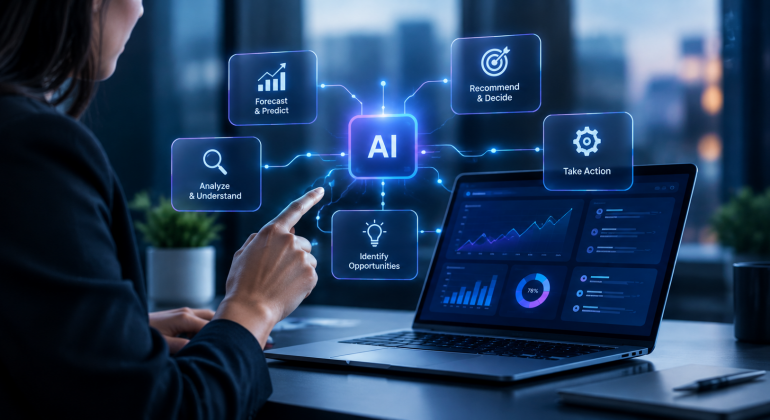
AI Powered Decision Making How Businesses Are Moving From Insights to Action
 Sarahi Perez
From Understanding Information to Taking Action Artificial intelligence has changed the way businesses collect, analyze, and understand information. But the next stage of AI is going beyond insights. Organizations are increasingly looking for ways to use AI to support real business decisions and determine what …
AI Native Software: Why the Next Generation of Applications Will Be Built Differently
Why Building for AI From the Start Is Changing Software Development Artificial intelligence is no longer simply a feature that businesses add to existing applications. It is becoming part of the foundation on which new digital products are designed. AI-native software represents a shift in …

AI Observability: The Missing Layer for Reliable Intelligent Systems
Why Businesses Need Visibility Into How AI Performs Artificial intelligence is becoming deeply integrated into modern business operations. Organizations are using AI to analyze information, automate processes, support employees, and improve customer experiences. But as AI systems become more sophisticated, a new challenge is emerging: …
High Quality Data for AI: Smarter Business Decisions
High-quality data is the foundation of every successful AI initiative. Many organizations invest in advanced AI models expecting immediate business value. However, the effectiveness of artificial intelligence depends less on the technology itself and more on the quality, consistency, and accessibility of the data it …

Technical Debt in the AI Era: Why Modern Software Matters
Introduction Technical debt has become one of the biggest obstacles to digital innovation. Many organizations assume technical debt simply means maintaining old code or outdated applications. In reality, it is much broader. Technical debt represents the accumulated cost of short term technology decisions that eventually …
Agentic AI When Software Starts Taking Initiative
Unlike traditional AI systems that respond to prompts or automate individual tasks, agentic AI can pursue goals, coordinate actions, and adapt to changing conditions with minimal human intervention. As organizations continue investing in intelligent technologies, agentic AI is emerging as a powerful driver of business …

Predictive Intelligence: The Future of Digital Experiences
Introduction Predictive intelligence is becoming one of the most important drivers of digital transformation in 2026. Businesses are no longer focused only on reacting to customer actions or operational challenges. Instead, organizations are increasingly using AI and data driven technologies to anticipate behaviors, identify patterns, …
AI Without Interfaces The Rise of Invisible Intelligence
Introduction Invisible intelligence is transforming how people interact with technology in 2026. Artificial intelligence is no longer limited to visible chatbots, dashboards, or standalone tools. Instead, AI is becoming deeply integrated into digital experiences, operating quietly in the background to automate actions, personalize interactions, and …

AI Workflows Why Businesses Are Moving Beyond AI Tools
AI workflows are becoming the next major step in digital transformation for businesses in 2026. Artificial intelligence is evolving faster than ever, and organizations are beginning to realize that using isolated AI tools is no longer enough. In recent years, companies adopted AI to automate …

Embedded Finance Beyond Traditional Banking
Introduction Embedded finance is transforming the way people interact with financial services in 2026. Banking is no longer limited to traditional institutions, physical branches, or standalone banking apps. Instead, financial services are becoming integrated directly into the digital platforms people already use every day. From …